


Théâtre Garonne
Cònsolo
Daniele De Michele et Julien Cassier
Intimate and Political Stories of Italian Cuisine
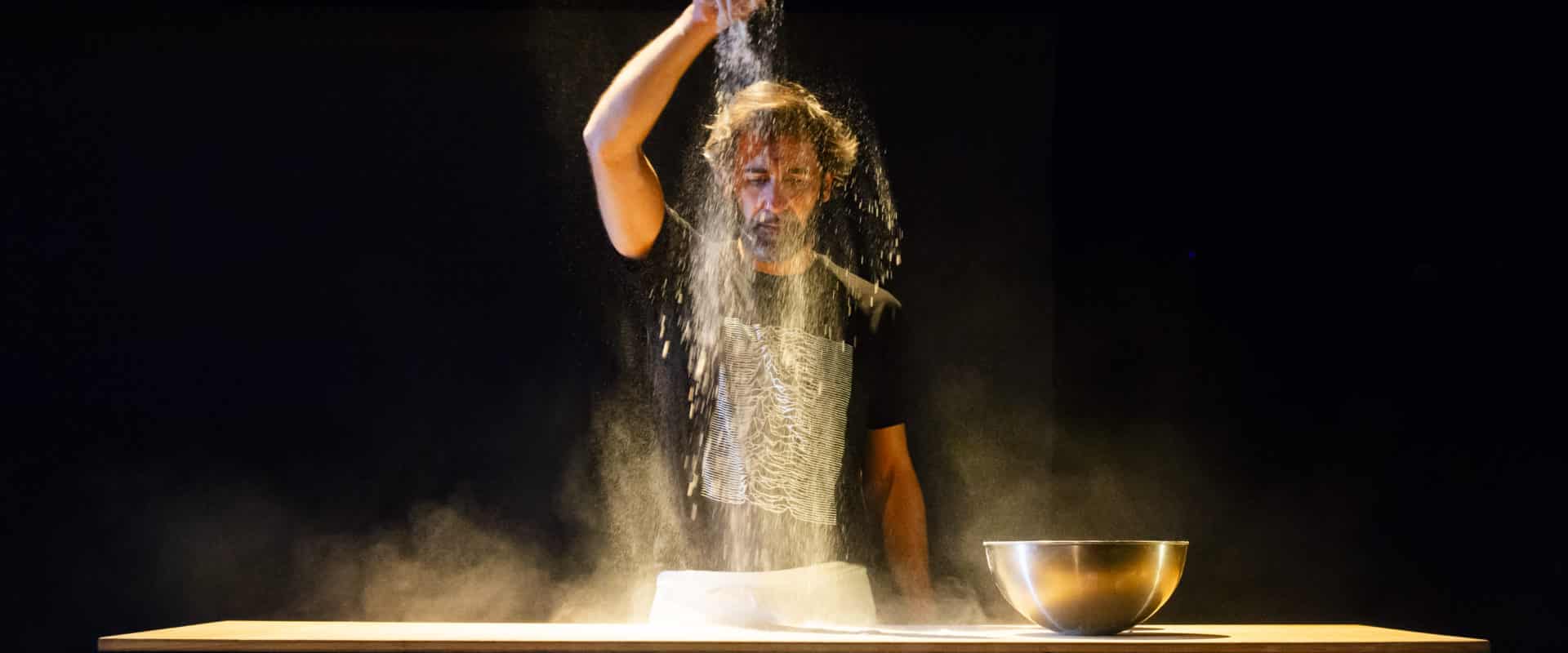
Performer, researcher, and filmmaker Daniele De Michele invites us into his kitchen, where every evening he prepares one of Italy’s most popular dishes: pasta al sugo con le polpette.
An economist by training, Daniele De Michele has been studying the relationship between modern societies and cooking and food for over twenty years. He views the preparation of a meal as a gift, a social act that has persisted from village communities to the present day. One day, he decided to follow his grandmother into the kitchen with his camera to capture her secrets. This marked the beginning of an anthropological journey across Italy. Following in the footsteps of the great Pellegrino Artusi—the father of Italian cuisine and the first collector of Italian recipes—he discovered the importance of the gesture, the experience, and the transmission of knowledge.
In this one-man show, which he wrote and performs for the first time on stage, he tells his story, shares his passion for cooking, and explores his political reflections, weaving together family memories, anthropological inquiry, archival footage, and live cooking. “Cònsolo”—the name of the meal offered by neighbors to bereaved families—celebrates cooking here as a simple, universal, collective, and comforting act.
Cònsolo is a practice that touches on two essential aspects of human existence: food and death. Consolo is not merely a way to lighten the burden on a day when you have too much on your mind and are suffering. It is a relief for the mind and a comfort to the soul to know that someone is thinking of you.
Daniele De Michele - Concept, Writing, and Performance
Trained as an economist, Daniele De Michele became a culinary anthropologist through his long-term research into Italian cuisine. He is a filmmaker and the author of numerous books on the subject. He is also a performer and regularly takes the stage as a chef and DJ. He is described by The New York Times as “one of the most
inventive activists in the food movement.” His first film, *I Villani*, co-produced by Rai Cinema and funded by Mibac, was presented at the Venice Film Festival’s Days of the Authors and, following an extensive national and international tour, premiered exclusively on Rai3 as a special episode of *Geo*. He collaborates with *Geo And Geo* (Rai3), *La Effe*, and *Fahrenheit* (Radio3). In 2014, he published *Artusi Remix* (Mondadori), the result of a collaboration with the Casartusi Scientific Committee. He produced the web-TV series *Le nonne d’Italia in cucina* for Treccani and *Corriere della Sera*, a journey through Italy’s twenty regions to meet grandmothers in their kitchens. His first project, Food Sound System, became a book, published by Kowalski, and a multimedia show that has been on a world tour for ten years now. In February 2013, he published *La Parmigiana e la Rivoluzione*. He writes regularly for *La Repubblica*, *Corriere della Sera*, and *Left*.
Julien Cassier - Artistic collaboration
After a career in the circus that took him on the road at a very young age with a traveling circus—amidst carriages, horses, and the big top—he enrolled at the Lido, the Higher School of Circus Arts in Toulouse, and later joined the National Center for Circus Arts. He co-founded various companies,
including Baro d’evel and the GdRA, and collaborated as a performer with several artists and directors.
At the GdRA, which he has co-directed since 2005, he weaves connections between storytelling and choreography. Within the collective, he created Singularités Ordinaires (winner of Circus Next) in 2007 and Ethno-graphiques, two pieces invited to the 64th Festival d’Avignon.
He has contributed to the writing of some twenty plays, including: Le triptyque de la Personne; Singularités Ordinaires; Nour et Sujet; La Guerre des Natures; Siffleurs de danse; Au milieu des terres and Bois Sacré.
As a performer, Julien Cassier took part in the production of *Le Luthier de Venise* at the Théâtre du Châtelet in Paris, an opera by Gualtiero Dazzi, directed by Giorgio Barberio Corsetti with musical direction by Alain Altinoglu. With Aurélien Bory and the Compagnie 111, he created the piece.
More or Less Infinity.
More recently, he reprised the role of Mazùt in Baro d’evel at the invitation of Camille Decourtye and Blaï Mateu Trias. He also performs in *Talk-Show*, a play by Gaël Santisteva.
Julien Cassier is regularly invited as an artistic collaborator, notably by Stéphanie Fuster on her Don Quixote, une femme à la tâche, by the Acrobatique de Tanger group alongside Aurélien Bory and Zimmermann & de Perrot and Maroussia Diaz Verbèke.
In 2026, he founded his company Nature Fauve and coordinates the production space Ça se passe à la Cave.
Distribution
Concept by Daniele De Michele and Julien Cassier
Performance and Text by Daniele De Michele
Dramaturgy by Charlotte Farcet, Daniele De Michele, and Julien Cassier
Directed by Aurélien Bory
Set Design and Stage Management by Matthieu Bony
Lighting Design by Hervé Dilé
Images by Antonello Carbone, Davide Di Gandolfo, and Julien Cassier
Stage Manager Assistant Ricardo Gaiser
Production
Produced by Théâtre Garonne and GdRA – Association Nos Autres
Executive production by Théâtre Garonne, Scène Européenne – Toulouse
Co-produced by Le Channel, Scène Nationale in Calais; Théâtre 71, Scène Nationale in Malakoff
Institutional partners Haute-Garonne Department, DRAC Occitanie, Occitanie Region, City of Toulouse
Your contacts in Avignon (pro only)
Fanny Ribes
+33 6 46 97 17 04 / f.ribes@theatregaronne.com
21:35 > 23:45shuttle ride included
13 > 21.07
Break on July 16
Château de Saint-Chamand Route /
Show 21:55 > 23:25
From 12 years old
Full Price : 24€
Off Rate : 16,50€
Pro Price : 10€